
Tri-Layer vs
Single-Layer
Aligners
Podcast on this blog is available now! →
Tri-Layer vs Single-Layer Aligners: What’s the Difference?
Tri-Layer vs Single-Layer Aligners differ mainly in how their materials are built and how those materials behave during treatment. Single-layer aligners are made from one thermoplastic material, while Tri-Layer Aligners combine three layers to balance flexibility, strength, shape stability and force delivery. ClearPath Aligners use a PCTG + TPU + PCTG structure in a 30:40:30 ratio. This layered design is intended to combine the structural qualities of PCTG with the elasticity of TPU. However, material is only one part of successful clear aligner treatment. Diagnosis, treatment planning, patient compliance and clinical monitoring all remain essential for achieving predictable results.
What Are Clear Aligners Made Of?
Clear Aligners are removable orthodontic trays made from transparent medical-grade polymers. Although they may look almost identical to patients, different brands can use different materials, thicknesses and manufacturing methods.
Common aligner materials include PETG, PCTG, TPU, polyurethane-based polymers and multi-layer thermoplastic combinations. Each material has its own mechanical properties. Some materials are more rigid, while others offer greater flexibility or elastic recovery. These differences can affect how an aligner fits, how it responds to pressure and how well it maintains its shape during the recommended wear period.
This is why the material used in an aligner matters. A clear aligner must be flexible enough to be inserted and removed comfortably, but it also needs enough strength to support the planned tooth movement. It should remain clear, resist cracking and maintain its form while being worn for many hours each day.
What Are Single-Layer Aligners?
Single-Layer Aligners are made from one thermoplastic material throughout the tray. This means the same material is responsible for the aligner’s flexibility, rigidity, shape retention and force response.
Single-layer materials have been used successfully in orthodontics for many years. Their performance depends on the type of polymer, its thickness and how it is processed. Some single-layer materials are more rigid and may produce stronger initial forces. Others are softer and more flexible.
The main limitation of a single-layer design is that one material has to perform several different jobs at the same time. A material that is very rigid may be less flexible, while a material that is very flexible may provide less structural support. This does not mean single-layer aligners are ineffective. It simply means their performance depends heavily on the properties of the one material being used.
What Are Tri-Layer Aligners?
Tri-Layer Aligners are made from three integrated layers rather than one uniform material. The aim is to combine the useful properties of different polymers within a single aligner.
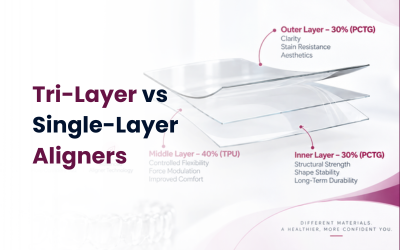
ClearPath’s Tri-Layer Aligners use PCTG + TPU + PCTG in a 30:40:30 ratio. The outer and inner layers are made from PCTG, while TPU forms the central layer.
This approach allows each layer to contribute a different function. The PCTG layers provide structure and support, while the TPU layer provides flexibility and elastic recovery. Together, these materials are designed to create a more balanced aligner that can remain stable while still adapting to the teeth during wear.
The benefit of a tri-layer system is not simply that it contains more material. The purpose is to engineer the aligner so that different layers contribute different mechanical properties.
PCTG and TPU: Why Are Both Used?
PCTG and TPU have different material characteristics, which is why they can work well together in a layered aligner structure.
PCTG is a transparent copolyester. It is commonly valued for its clarity, structural stability and ability to be thermoformed accurately. These characteristics make it useful for the outer portions of an aligner where shape retention and surface quality are important.
TPU, or thermoplastic polyurethane, is more elastic. It can flex and recover in a way that differs from a rigid copolyester. When used as a central layer, TPU can help provide controlled flexibility and support the aligner’s ability to return toward its intended shape.
By combining PCTG and TPU, a Tri-Layer Aligner can be designed to balance rigidity and elasticity rather than relying on one material for every function.
The biggest difference between Tri-Layer vs Single-Layer Aligners is their construction. Single-layer aligners use one thermoplastic material, while tri-layer aligners combine multiple materials within one tray.
This difference can influence several characteristics, including flexibility, structural stability and force response. In a single-layer aligner, all of these properties depend on the performance of one polymer. In a tri-layer aligner, different materials can be selected to perform different roles.
Single-layer aligners may be simpler in design, but tri-layer systems allow manufacturers to engineer the material more precisely. For example, rigid outer layers can help maintain shape while an elastic inner layer can support flexibility and recovery.
It is important to understand that this does not automatically mean every tri-layer aligner will produce better treatment results. Clinical outcome depends on much more than material construction.
How Aligner Materials Help Move Teeth
Clear Aligners move teeth by applying controlled orthodontic forces. Each aligner is manufactured according to a planned tooth position. When the tray is placed over teeth that have not yet reached that position, the material flexes slightly.
The aligner then tries to return toward its manufactured shape. This creates the force that helps guide the teeth gradually.
The way the material behaves during this process is important. A material that is too stiff may produce excessive initial pressure, while a material that is too soft may not provide enough structural control. The goal is to maintain a useful balance between flexibility and force.
This is one reason aligner material technology continues to develop. Manufacturers are trying to create materials that maintain useful force over time while remaining comfortable and durable enough for daily wear.
Why Stress Relaxation Matters
Stress relaxation is an important concept in clear aligner materials. It describes how the force inside a material gradually decreases while the material remains under constant strain.
When a patient first places an aligner, the tray may produce a relatively strong initial force. Over time, that force can decrease as the material relaxes.
All thermoplastic aligners experience some degree of stress relaxation. The rate and amount of force reduction can vary depending on the material, thickness, temperature and oral conditions.
A good aligner material should aim to maintain clinically useful force throughout the prescribed wear period. This is one reason multi-layer materials are designed to combine different mechanical properties rather than relying on a single polymer alone.
Flexibility and Elastic Recovery
Flexibility is important because patients need to insert and remove their aligners every day. The tray must bend enough to pass over teeth and attachments without cracking or becoming permanently distorted.
At the same time, the aligner should have enough elastic recovery to return toward its original planned shape after being removed or flexed.
TPU is useful in this area because of its elastic characteristics. When it is placed between structural PCTG layers, the material system can be designed to provide flexibility without losing too much support.
This balance can help the aligner feel more manageable during insertion and removal while still maintaining the shape required for treatment.
Durability During Daily Wear
Aligners are exposed to challenging conditions every day. They are repeatedly inserted and removed, exposed to saliva and temperature changes and subjected to normal chewing and biting forces.
These conditions can affect material properties over time. Some aligners may become softer, more flexible or more prone to distortion after extended wear.
Material durability is therefore an important part of aligner design. The goal is not simply to create a tray that fits well on the first day. It should continue to perform throughout the wear period recommended by the treating clinician.
A layered material system can help distribute different roles across the aligner structure. The outer layers can provide surface and structural support while the inner layer contributes elasticity.
How ClearPath Tri-Layer Aligners Work
ClearPath Tri-Layer Aligners use a PCTG + TPU + PCTG construction with a 30:40:30 ratio. The design is intended to balance strength, clarity, flexibility and force delivery within one aligner.
The outer PCTG layer supports surface quality and structural stability. The middle TPU layer provides flexibility and elastic recovery. The inner PCTG layer provides additional support and helps the aligner maintain its intended form.
This material system is only one part of the overall treatment process. The aligner still needs to be created according to a clinically planned tooth movement sequence.
ClearPath treatment typically begins with a dental assessment and digital records. The clinician evaluates the patient’s teeth and bite, then a digital treatment plan is created. A sequence of aligners is manufactured to guide the teeth through planned stages of movement.
Who May Be Suitable for Clear Aligners?
Clear Aligners can be used to treat many orthodontic concerns, but they are not suitable for every patient.
They may be considered for people with crowded teeth, spacing, rotated teeth, mild to moderate bite problems and some cases of orthodontic relapse. In more complex cases, aligners may still be used, but additional features such as attachments, elastics or other orthodontic techniques may be required.
A professional assessment is important because treatment suitability depends on more than how the teeth look. Gum health, bone support, jaw relationships and the type of tooth movement required all need to be considered.
Patients should avoid choosing an aligner system based only on appearance or material claims. The most important first step is a proper clinical diagnosis.
Does the Aligner Material Affect Treatment Time?
The material can influence how force is delivered, but it does not determine treatment time by itself.
Treatment duration depends on the complexity of the case, the number of teeth being moved, the type of movement required and how well the patient follows the prescribed wear schedule.
Some cases may take only a few months, while others may require a longer treatment period. Refinements may also be needed if the teeth do not track exactly as planned.
This is why it is not accurate to say that Tri-Layer Aligners automatically move teeth faster than Single-Layer Aligners. Material design can support treatment, but treatment speed depends on many clinical factors.
Potential Benefits of Tri-Layer Aligners
The main advantage of a Tri-Layer Aligner is the ability to combine different material properties within one tray.
This may allow the aligner to achieve a better balance between rigidity and flexibility. The outer layers can help the aligner retain its form, while the elastic middle layer can help it flex and recover.
Other potential benefits include improved resistance to repeated insertion and removal, controlled force characteristics and a more balanced feel during wear.
However, these benefits should always be discussed carefully. Material design can support treatment performance, but it does not guarantee a particular clinical result.
Limitations Patients Should Understand
No aligner material is perfect. Both Single-Layer Aligners and Tri-Layer Aligners have limitations.
The material can only work correctly when the aligner fits properly and follows a suitable treatment plan. Poor compliance can reduce treatment effectiveness regardless of how advanced the material is.
Patients also respond differently to orthodontic forces. Teeth may move at different rates, and some movements are more difficult to achieve than others.
This means a more advanced material should not be viewed as a replacement for professional supervision. The clinician still needs to monitor progress and make changes if the teeth are not moving as expected.
Does Better Material Mean Better Treatment?
Better material can support better treatment, but it is not the only factor.
Successful clear aligner treatment depends on the relationship between material technology and clinical planning.
The dentist or orthodontist must determine how much each tooth should move, when it should move and whether attachments or other techniques are required. The aligner then delivers the planned forces.
Patient compliance is equally important. Clear Aligners must be worn according to the clinician’s instructions. If they are not worn for the recommended amount of time, even a well-designed aligner may not perform as planned.
The most predictable results come from a combination of suitable material, accurate digital planning, professional monitoring and good patient compliance.
ClearPath’s Approach to Clear Aligner Treatment
ClearPath Aligners combine material technology with clinician-led digital treatment planning.
The Tri-Layer system uses PCTG + TPU + PCTG in a 30:40:30 structure. The aim is to provide a material balance that supports flexibility, durability and controlled force delivery.
ClearPath also emphasizes clinical planning. Each case is assessed individually, and aligners are created according to a staged treatment plan rather than a one-size-fits-all approach.
For patients, this is important because the effectiveness of Clear Aligners does not come from the material alone. The treatment plan, monitoring and patient cooperation all contribute to the final outcome.
What Determines the Cost of Clear Aligners?
Clear aligner cost usually depends more on the complexity of treatment than on whether the tray is single-layer or tri-layer.
A simple case may require fewer aligners and fewer appointments. A more complex case may require a longer treatment plan, more aligners, attachments and additional refinements.
Other factors that can affect cost include diagnostic records, doctor fees, retainers, clinic location and the amount of clinical monitoring required.
Patients should therefore avoid comparing aligner systems based only on the price of the trays. It is more useful to understand what is included in the overall treatment plan.
Tri-Layer vs Single-Layer Aligners: Which One Should You Choose?
When comparing Tri-Layer vs Single-Layer Aligners, it is helpful to look beyond the appearance of the tray. Single-layer aligners use one thermoplastic material to provide all of the required mechanical properties. Tri-layer systems combine different materials so that each layer can contribute a specific function.
ClearPath’s PCTG + TPU + PCTG 30:40:30 Tri-Layer system is designed to balance structural support, flexibility and force delivery. This material approach can provide useful engineering advantages, but material alone does not determine treatment success.
The best aligner system is the one that combines suitable materials with accurate diagnosis, careful treatment planning, regular monitoring and good patient compliance.
If you are considering ClearPath Aligners, the first step should be a professional assessment to determine whether clear aligner treatment is suitable for your teeth and bite.