
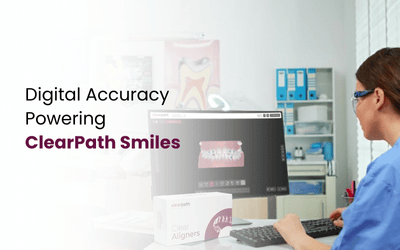
Digital Accuracy Powering
ClearPath Smiles
Podcast on this blog is available now! →
Digital Workflow Behind Every ClearPath Smile
Digital workflows are transforming orthodontic care. Using 3D scanning and advanced software, ClearPath orthodontists can plan and produce clear aligners with unprecedented precision. Every treatment step from digital assessment to manufacturing is computer-guided for exact results. In Pakistan, ClearPath Orthodontics is leading this shift. We were the first in-house aligner manufacturer in Pakistan and our Lahore lab combines global technology with local expertise. This ensures every patient gets a custom plan and appliance made to strict standards.
Read More: Straight Teeth with ClearPath Aligners
What Is a Digital Workflow in Clear Aligner Treatment
A digital workflow uses computer tools at each stage of treatment. Instead of physical molds, 3D scans of the teeth are taken and imported into software. Orthodontists then use CAD/CAM tools to plan tooth movements and design aligners. The digital model guides the manufacturing of each tray. For patients, this means a more comfortable and predictable experience: the outcome is mapped in advance and aligners fit precisely to your teeth.
Step One: Digital Patient Assessment
Digital Smile Evaluation
Dentist using an intraoral 3D scanner to capture a patient’s teeth. Before scanning, ClearPath doctors evaluate the patient’s smile. High-resolution photos and facial images are taken to understand facial balance and tooth proportions. We analyze how each tooth position affects your overall smile line. This digital smile assessment uses specialized software to plan cosmetic and functional goals even before treatment starts. It helps the orthodontist design a result that looks natural and suits your face.
3D Dental Scanning
Dentist using a handheld intraoral scanner in the patient’s mouth. Next, an intraoral scanner captures your teeth in 3D. The dentist gently sweeps a wand inside your mouth, taking thousands of images in minutes. This replaces messy impression putty and is far more comfortable. You can even watch the live scan on a screen. The result is a detailed digital model of your teeth and bite. This high-definition model ensures the aligners will fit snugly and work exactly as planned. Patients report much less discomfort and gagging compared to old methods and the precise scan saves time on refinements.
Treatment Planning with Advanced Digital Tools
AI Assisted Orthodontic Planning
After scanning, our doctors use sophisticated planning software. ClearPath’s system leverages AI-powered tools to analyze your 3D model. The AI examines your dental anatomy and suggests the optimal sequence of tooth movements. Doctors can review and adjust the plan on screen. This smart planning creates a highly personalized treatment strategy. Because the software learns from large datasets, it can predict each tooth’s response more accurately. In practice, AI-driven plans help shorten treatment time and improve comfort by applying ideal forces to each tooth.
Predictable Tooth Movement Simulation
Once the digital plan is finalized, the software provides a virtual simulation of your treatment. Both doctor and patient can see how the teeth will move at each stage. Seeing a digital preview builds confidence: you know what to expect and when. This visual roadmap keeps treatment on track. Studies show that having a virtual preview leads to more predictable outcomes and fewer mid-course corrections. In our experience, patients feel more motivated when they see the projected result and orthodontists can ensure every step stays true to the plan.
Digital Design of ClearPath Aligners
Three clear aligner trays created with advanced digital design. With the treatment plan approved, ClearPath uses CAD/CAM technology to design and manufacture each aligner. Orthodontists customize the fit on-screen, placing attachments and fine-tuning tooth positions before any plastic is formed. The aligner shape is then generated exactly to the digital specifications. This level of doctor-controlled design gives unmatched precision: each aligner is custom-built to the patient’s teeth with micron-level accuracy. It also delivers accuracy and consistency:
Precision: Every aligner is crafted to match the digital model perfectly. ClearPath’s digital modeling means each tray is made to fit your teeth exactly.
Accuracy: The CAD/CAM process ensures the aligner shape and attachments match the orthodontist’s plan. This high precision improves the fit and performance of the aligners.
Consistency: Automated manufacturing removes human error. Every aligner in a series is formed the same way, so tooth movements stay on schedule and power levels remain reliable.
These benefits mean the aligners deliver the forces and movements predicted by the plan, stage after stage.
ClearPath Orthodontics manufactures every aligner in our Lahore facility. We have an end-to-end digital lab right here in Pakistan. High-resolution 3D printers produce exact dental models of your teeth. Medical-grade plastic sheets are then vacuum-formed over these models to create each clear tray. Because all production is local, doctors and patients enjoy faster service and easy communication. An approved treatment plan goes straight to our lab’s printers and forming machines, so aligners are ready in days, not weeks. These trays are FDA- and DRAP-approved and made with 3D precision, giving doctors confidence and patients peace of mind. Local manufacturing also means we can quickly apply any doctor-requested tweaks or rush cases if needed.
Quality Control at Every Digital Stage
Every step of the ClearPath process includes rigorous quality checks. First, our software performs a “digital triple-check” on the scan and plan to catch any errors. The system flags holes, distortions or unrealistic movements in the digital model before production. Next, we produce a 3D-printed model of the patient’s teeth and scan it back to verify it matches the original design. Printers are taken offline if they drift out of calibration. Finally, after thermoforming, each aligner is computer-trimmed and inspected against the plan. These checks – from software to printer to finished tray – ensure that every aligner fits exactly as intended. Doctors can trust that the appliance delivered to the patient has met strict medical standards. This focus on quality gives both clinicians and patients confidence in the safety and effectiveness of the treatment.
Read More: How to Manage Clear Aligners While Fasting
Benefits of Digital Workflow for Doctors
Digital orthodontic workflows offer major advantages for treating dentists.
Clinical efficiency: 3D scans and automated planning cut down time. Digital models mean less manual work and faster lab turnaround. Dentists can handle more cases with less chair time.
Predictable outcomes: Seeing a virtual treatment plan gives clear targets. Doctors know exactly how teeth should move, reducing surprises and mid-treatment changes.
Treatment control: The entire case is editable on-screen. Orthodontists can fine-tune the plan anytime and closely supervise the treatment progress. This gives them complete control over each patient’s plan from start to finish.
These benefits make clinical practice smoother. With digital tools, doctors have consistent, evidence-based treatment steps and can manage cases more effectively.
Benefits of Digital Workflow for Patients
Patients enjoy a more comfortable, accurate and satisfying experience with digital aligners:
Comfort: Digital scans replace gooey impression material, so no gagging or messy molds. Aligners themselves are smooth and precisely trimmed, causing minimal irritation.
Accuracy: The precise 3D scan and digital planning mean each aligner fits snugly from day one. Better fit reduces sore spots and tracking issues.
Faster treatment: Computer-aided design and manufacturing speed up the process. With less trial-and-error, aligner cases often finish sooner.
Confidence: Patients can see a digital preview of their future smile before treatment. Using nearly invisible trays adds self-esteem. Knowing the technology has been double-checked by experts also makes patients feel more assured about the outcome.
These patient advantages help ensure high satisfaction and compliance during treatment. Better comfort and visualization keep patients engaged and confident in the care they’re receiving.
Read More: Why Dentists Are Switching to Clear Aligners
Digital Workflow and the Future of Orthodontics
The digital evolution is just beginning. New trends – like cloud-based treatment planning, real-time 3D printing and AI-driven monitoring – will continue to improve orthodontics. Industry reviews highlight the integration of AI with robotics and on-demand aligner fabrication as coming developments. In Pakistan, ClearPath is staying ahead by investing in these technologies. Our digital platform is built to scale, so more doctors across Lahore and other cities can utilize advanced orthodontic tools. As adoption grows, expect shorter treatment times and more remote consultation options. Ultimately, digital orthodontics will make state-of-the-art care accessible nationwide. ClearPath’s combination of local expertise and cutting-edge tech means we’re ready to bring these innovations to Pakistani patients and doctors.
Final Thoughts
At ClearPath, we combine technology with expertise to deliver better orthodontic care. Our fully digital workflow – from 3D scan to final aligner – ensures precision and predictability in every case. Because we manufacture aligners locally in Lahore, we maintain tight quality control and fast turnaround. Doctors and patients can trust our digital process: it’s backed by research, rigorous testing and certified clinicians. ClearPath’s commitment to innovation and safety means you get the most advanced, dependable aligner treatment available in Pakistan. In the end, our goal is simple: precise, comfortable smile improvements that you can rely on, every step of the way.
FAQs
It’s the use of computer-based tools from start to finish – 3D scans, virtual treatment planning, and CAD/CAM manufacturing – instead of traditional molds and lab work. This end-to-end digital process yields more precise and efficient aligner treatments.
By simulating each tooth movement on-screen, digital planning customizes every aligner for your case. In other words, each tray is tailored exactly to your dental anatomy, which improves accuracy and often cuts down treatment time.
Yes. Systems like ClearPath meet international safety standards. For example, our aligners are FDA- and DRAP-approved and made from medical-grade materials in Lahore. Treatments are supervised by trained orthodontists and follow strict quality protocols for patient safety.