
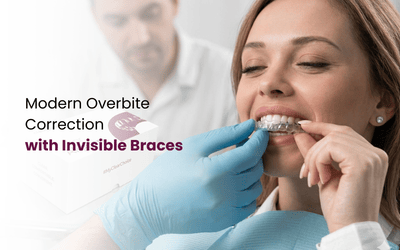
Modern Overbite Correction
with Invisible Braces
Do You Really Need Braces to Fix an Overbite?
When you look in the mirror and notice your upper front teeth protruding significantly over your lower ones, your first thought might be, “Do I really need braces to fix an overbite?” For decades, traditional metal braces were the only solution for this common malocclusion. However, as dental technology has evolved, many patients are finding that they don’t necessarily need metal wires and brackets to achieve a perfectly aligned smile. Whether your overbite is a minor cosmetic concern or a functional issue causing jaw pain, understanding your options—including modern clear aligners—is the first step toward a healthier, more confident you.
Read More: Pakistan’s First DRAP Approved Clear Aligner
Understanding the Overbite: More Than Just a Smile
An overbite occurs when the upper teeth overlap the lower teeth vertically. While a small overlap (about 2-4mm) is actually healthy and necessary for proper chewing, an excessive overbite can lead to a host of issues. These include uneven tooth wear, speech impediments, and even Temporomandibular Joint (TMJ) disorders.
The core question remains: Is orthodontic intervention mandatory? If the overbite is skeletal (related to jaw bone structure) or severe enough to cause health complications, correction is highly recommended. The good news is that “braces for overbite” is no longer the only search term you need to know.
While traditional braces are the “gold standard” for extreme skeletal misalignments, clear aligners have become a powerhouse for treating mild to moderate (and even some complex) overbite cases.
Traditional Braces for Overbite
Braces use a system of metal or ceramic brackets bonded to the teeth, connected by an archwire. They are exceptionally effective at moving teeth in 3D space and can be paired with elastics or Herbst appliances to shift the jaw.
Clear Aligners for Overbite Correction
Clear aligners, like those offered by ClearPath Orthodontics, use a series of custom-made, transparent plastic trays. These trays apply gentle, consistent pressure to shift teeth into position. Modern aligners can now incorporate “precision ramps” and elastics, making them a viable alternative to braces for many overbite patients.
Benefits of Clear Aligners
Choosing aligners over traditional braces offers several lifestyle and clinical advantages:
Near Invisibility: Most people won’t even notice you’re wearing them.
Removability: You can take them out to eat, brush, and floss, ensuring better oral hygiene.
Comfort: No sharp metal wires to poke or irritate your cheeks and gums.
Predictability: Advanced 3D planning allows you to see your final result before you even start.
No Dietary Restrictions: Since you remove them to eat, you can still enjoy popcorn and nuts.
Features of ClearPath Aligners
FDA & DRAP Approved: High-quality medical-grade plastic.
Smooth Trim Line: Scalloped edges for maximum gum comfort.
Stain Resistant: Stays clear and discreet throughout the wear period.
Custom 3D Design: Each tray is mathematically calculated for your specific bite.
Feature | Traditional Braces | Clear Aligners (ClearPath) |
|---|---|---|
Visibility | High (Metal/Ceramic) | Virtually Invisible |
Comfort | Can be abrasive | Smooth and comfortable |
Hygiene | Difficult to clean | Very easy (Removable) |
Treatment Time | 18–36 months | 6–18 months (varies) |
Compliance | Not required (Fixed) | High (Must wear 22 hrs/day) |
Complexity | Best for severe skeletal cases | Excellent for dental overbites |
The Step-by-Step Process of Overbite Correction
How exactly do you go from a protruding bite to a perfect smile? Here is the journey with ClearPath:
Step 1: The Consultation & Scan
Your orthodontist performs a comprehensive exam. Instead of messy putty impressions, ClearPath uses high-definition 3D intraoral scans to create a digital map of your mouth.
Step 2: 3D Treatment Planning
Using specialized software, our experts plan the movement of every single tooth. You will get to view a digital simulation of your future smile.
Step 3: Manufacturing Your Trays
Once the plan is approved, a series of custom aligners is 3D-printed. Each tray is slightly different, designed to move your teeth incrementally.
Step 4: The Wear Phase
You wear each set of aligners for about 1 to 2 weeks for at least 22 hours a day. You’ll visit your doctor periodically (usually every 6–8 weeks) to check progress.
Step 5: The Reveal & Retention
Once the last tray is finished, your overbite is corrected! You will then be fitted for a retainer to ensure your teeth stay in their new, beautiful positions.
How It Works: The Science of Tooth Movement
Aligners work through the principle of controlled force. Traditional braces pull teeth into place, while aligners push them. To fix an overbite, the aligners may perform “intrusion” (pushing the front teeth slightly up into the bone) or “extrusion” (bringing the back teeth up to level the bite). In many cases, “attachments”—tiny tooth-colored bumps—are placed on the teeth to give the aligners more grip for complex movements.
Why Choose ClearPath Orthodontics?
ClearPath is a leader in invisible orthodontics, providing thousands of patients with a path to a better smile without the “metal mouth” look. Our aligners are designed with the latest biomechanical research to ensure that overbite correction is not just aesthetic, but functional and lasting.
Conclusion: Take the First Step
So, do you really need braces to fix an overbite? Not necessarily. While braces remain a powerful tool, clear aligners for overbite offer a comfortable, discreet, and effective alternative for the modern lifestyle. Don’t let a misaligned bite hold back your confidence or affect your dental health.
FAQs
1. Can aligners really fix a deep overbite?
Yes! While they were once limited to minor crowding, modern clear aligner technology can effectively treat many deep overbite cases, often using elastics just like traditional braces.
2. How long does it take to fix an overbite with aligners?
The timeline varies depending on severity, but most patients see results within 12 to 18 months. Mild cases can be resolved in as little as 6 months.
3. Are clear aligners more expensive than braces?
The cost is often comparable. In many regions, clear aligners are becoming more affordable due to streamlined digital manufacturing processes.
4. Do I have to wear them at night?
Yes. To be effective, aligners must be worn 20–22 hours a day, including while you sleep. They should only be removed for eating and cleaning.
5. Will I need surgery?
Only in very severe “skeletal overbite” cases where the jawbone itself is significantly misaligned. Your orthodontist will determine this during your initial 3D scan.