
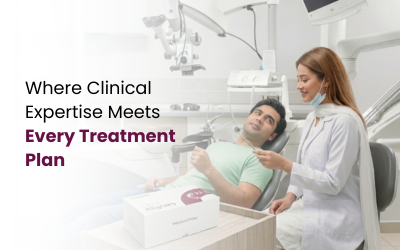
Where Clinical Expertise Meets
Every Treatment Plan
Podcast on this blog is available now! →
The Dentist Treating You Has Been Certified by ClearPath. Here Is What That Means
Not all orthodontic treatments are equal. The difference between a result you are proud of and one that causes long-term problems often comes down to a single factor – the experience and oversight of the professional managing your care.
ClearPath works exclusively with trained, qualified dental professionals, and every treatment plan is supervised from the first appointment to the final retainer. This article explains why that level of clinical accountability is not optional – it is the foundation of safe, predictable treatment.
Read More: Why Dentists Are Switching to Clear Aligners
Why Dentist Supervision Matters More Than You Might Think
Teeth are connected to bone, tissue, and roots – moving them is a clinical procedure, not a cosmetic one. A surface-level assessment – without X-rays, clinical examination, or proper bite evaluation – cannot tell you what is happening below the gum line.
Before treatment begins, a dentist checks for things that are easy to miss but critical to catch:
- Active gum disease
- Root resorption risk
- Existing restorations
- Bite issues that aligners alone cannot fix
Does the Level of Clinical Supervision Actually Make a Difference?
The short answer is yes – significantly. The longer answer is that the gap between a thoroughly supervised treatment and a poorly overseen one is not always visible at the start. It shows up mid-treatment, or after it ends, when the teeth have not moved as planned or new problems have emerged that were never properly assessed. Aligner treatment carried out by an inexperienced or inadequately trained provider carries real risks – not because the aligners themselves are the issue, but because the clinical decisions surrounding them matter enormously. Which teeth to move, in what sequence, at what force, and with what safeguards in place – these are clinical judgements, not administrative ones.
Reported issues with unsupervised aligner treatment include:
- Teeth that moved in the wrong direction due to poor case planning
- Worsened bite alignment that required more complex correction afterwards
- Gum recession triggered by force applied to already compromised tissue
- Relapse shortly after treatment because retention was not properly managed
The problem is not always visible while it is happening. Some of the damage caused by unsupervised treatment only becomes apparent months later, by which point it is more expensive and more difficult to correct than the original issue would have been.
The Real Difference Between Properly Supervised and Poorly Supervised Treatment
It is not just the product, it is everything built around it. Every ClearPath-Certified Dentist has access to a dedicated Dentist Portal, where they can track their patients’ aligner shipments, monitor case progress, and stay in direct contact with the ClearPath team throughout treatment. Before a single tray is made, the case is planned using CP Smart 2.0 – ClearPath’s smile simulation software – where the certified dentist reviews the full treatment plan, makes modifications based on the patient’s specific needs, and only approves it once everything looks right. Because the plan is reviewed and refined before fabrication begins, mid-course corrections are far less likely. Here is how that compares to a treatment without that level of clinical infrastructure:
Stage | ClearPath Supervised Treatment | Inadequately Supervised Treatment |
|---|---|---|
Assessment | Full clinical exam, X-rays, bite evaluation | Basic or no clinical assessment prior to treatment |
Planning | Dentist-reviewed digital treatment plan | No dentist review; plan not tailored to clinical needs |
Monitoring | Regular check-ins throughout treatment | Little to no in-person monitoring during treatment |
Problem-solving | Dentist adjusts plan if teeth are not tracking correctly | No structured process to identify or correct deviations |
Retention | Professionally planned retainer phase | No clinical follow-up; retention left to the patient |
Yes, and this is not a scare tactic. Patient safety in orthodontics depends on more than a well-designed tray – it depends on who is overseeing the process. Here is the clinical reality:
Understanding aligner biomechanics helps explain why supervision matters. Teeth move because of sustained, controlled pressure applied to the periodontal ligament – the tissue connecting each tooth to the surrounding bone. When that pressure is planned correctly, the bone remodels and the tooth moves safely. When it is not, the results range from uncomfortable to damaging.
- Too much force, applied too quickly, can cause root resorption – a shortening of the tooth root that is permanent and irreversible.
- Force applied to a tooth with undetected bone loss can accelerate that loss significantly.
- Incorrect movement sequences can rotate or tip teeth in ways that create new bite problems.
- Poorly fitting trays that are not caught early cause the teeth to stop tracking the plan and the remaining trays in the series then apply force in entirely the wrong direction.
These risks are real and well-documented. The good news is that with a ClearPath-Certified Dentist overseeing your treatment, you are not relying on one set of eyes. Every treatment plan is also reviewed by ClearPath’s own specialists through CP Smart 2.0 – meaning potential issues are cross-checked at both the clinical and the production level before they ever reach you.
People sometimes assume that aligner check-ups are just a formality – the dentist glances at your teeth, tells you everything looks fine, and sends you on your way. In reality, clinical monitoring of aligners involves quite specific assessments:
- Tracking verification
- Soft tissue assessment
- Attachment integrity
- Bite evaluation
- Refinement planning
Why Professional Aligner Treatment Produces Better Results
Beyond safety, there is a clinical reason why professional aligner treatment produces better outcomes: a dentist can fix things when they go off course and they almost always notice when something is drifting off course before it becomes a visible problem.
Treatment predictability – the likelihood that your teeth end up where they are planned to be – is significantly higher under clinical supervision. This is partly because the plan itself is better (built on a full clinical assessment rather than a photograph), and partly because deviations are caught and corrected in real time.
For patients in Pakistan looking for safe, clear aligners, this distinction matters. ClearPath works through a network of trained dental professionals across the country – including in Lahore and other major cities such as Karachi, Islamabad and many more – precisely so that patients have access to proper clinical oversight, not just a product delivered to their door.
Read More: How to Manage Clear Aligners While Fasting
End Note
Clear aligner treatment is not complicated to understand at a surface level – trays move your teeth over time, and eventually you get the smile you were working towards. But underneath that simplicity is a clinical process that involves bone, tissue, roots, bite mechanics, and a treatment plan that needs to respond to how your specific teeth actually move.
For patients looking for safe clear aligners in Pakistan, ClearPath uses dentist-supervised treatment because that is the only version of aligner care that is genuinely accountable.
There is a qualified professional responsible for your plan, your progress, and your outcome at every stage. That is not a marketing line – it is simply what proper clinical care looks like.
If you are considering clear aligners with a dentist and want to understand your options with the right clinical guidance, visit clearpathortho.com to find a trained ClearPath provider near you.