
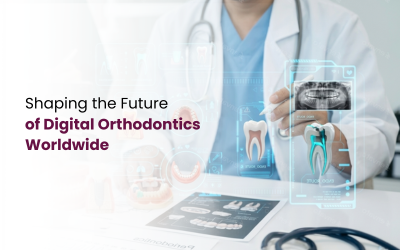
Shaping the Future
of Digital Orthodontics Worldwide
The Global Clear Aligner Market: Size, Trends, and 2030 Outlook
The orthodontic landscape is experiencing a structural shift, moving from conventional brackets and wires to digital, patient-centric solutions. At the forefront of this evolution is the global clear aligner market, which has transitioned from a premium aesthetic alternative into a primary treatment modality for malocclusion. Driven by advancements in material science, artificial intelligence, and localized high-precision manufacturing, the industry is expanding rapidly. This comprehensive market outlook analyzes the volume valuation in 2026, emerging technological breakthroughs, and the industry growth forecast leading up to 2030.
Read More: Pakistan’s First DRAP Approved Clear Aligner
How Big Is the Clear Aligner Market in 2026?
The global clear aligner market size 2026 has achieved substantial volume milestones, with millions of new clinical cases processed annually across centralized laboratory workflows and direct-to-consumer hybrid models. Industry data reveals a double-digit compound annual growth rate (CAGR), making it one of the fastest-growing sectors within medical devices and healthcare.
Geographic Distribution and Case Volume Share
- North America: Continues to command the largest market share, sustained by high orthodontic insurance coverage and early adoption of intraoral scanning.
- Asia-Pacific: Identified as the fastest-growing regional market, expanding rapidly due to rising disposable incomes, large patient pools, and expanding clinical distribution networks.
- Europe: Maintains a steady second position, characterized by strict regulatory compliance requirements and an increasing integration of digital workflows in standalone dental practices.
What Is Driving Demand? Key Growth Factors Explained
The robust momentum defining the aligner industry growth forecast is powered by a confluence of demographic shifts, clinical validation, and evolving consumer behavior.
1. The Proliferation of Adult Orthodontics
Historically, orthodontic intervention was viewed as an adolescent milestone. In 2026, the adult segment dominates the clear aligner market with a commanding majority share of total case volumes. Adult patients prioritize aesthetics, comfort, and the lack of social friction—qualities that traditional metal brackets cannot provide.
2. Escalating Global Prevalence of Malocclusion
The World Health Organization and contemporary clinical registries note a high global prevalence of dental malocclusion. With rising awareness of how misaligned teeth affect periodontal health, the demand for interceptive and corrective therapies has expanded beyond cosmetic preference into essential healthcare.
3. Clinician-Led Workflows Replacing Direct-to-Consumer (DTC)
The market has seen a sharp course correction away from unmonitored direct-to-consumer “mail-order” aligners. High failure rates and regulatory interventions have pushed patients back into dental offices, boosting the B2B sector where trained dental professionals oversee diagnostic planning and clinical progress.
Top Aligner Brands and Their Market Positions
The competitive structure of the global clear aligner market is highly concentrated yet progressively diversifying. Established multinational corporations share the landscape with agile regional manufacturers utilizing localized clinical support models.
B2B Specialized Manufacturers (ClearPath Aligners)
Positioned strategically as high-precision, doctor-first manufacturing partners, players like ClearPath Aligners provide certified, accessible alternatives to legacy Western-centralized brands, capturing substantial market share across developing dental economies.
Emerging Markets — South Asia, Middle East, and Latin America
While mature Western economies provide volume stability, the true frontier for exponential orthodontic market trends 2030 lies within emerging economic corridors.
South Asia and the Asia-Pacific Surge
Countries like India, Pakistan, and Thailand represent massive untapped opportunities. The growth here is characterized by a massive youth demographic, urbanization, and a rapidly expanding middle class demanding international-standard clinical care at optimized pricing structures.
The Middle East and North Africa (MENA)
The MENA region, particularly the GCC countries, shows high adoption rates for premium aesthetic dentistry. Investment in digital healthcare infrastructure and an influx of specialized dental clinics have turned this region into a high-revenue zone for ClearPath Aligners manufacturer pipelines.
Latin America
Led by Brazil and Mexico, this region benefits from a culturally deep-rooted emphasis on dental cosmetics and maxillofacial aesthetics, alongside a high density of qualified orthodontists transitioning to digital frameworks.
The Rise of B2B Manufacturers vs Direct-to-Consumer Brands
The clear aligner industry has undergone a major paradigm shift regarding delivery models. The historical tension between Direct-to-Consumer (DTC) entities and business-to-business (B2B) clinical models has reached a definitive conclusion.
The Pitfalls of At-Home DIY Aligners
The direct-to-consumer model, which bypassed the dental chair by shipping DIY impression kits directly to consumers, faced significant setbacks due to tracking errors, root resorption issues, and extensive litigation.
The Superiority of the Doctor-Led B2B Model
In 2026, the B2B model stands as the gold standard. In this setup, clear aligner manufacturers work directly with dentists and orthodontists. The manufacturer acts as the back-end technological and fabrication engine, while the local doctor provides face-to-face diagnosis, staging approval, and chairside attachment placement. This ensures:
- Biological Safety: Tooth movement is planned based on radiographic bone evaluation.
- Predictable Tracking: Mid-course corrections can be managed instantly by the clinician.
- Enhanced Customization: Specialized attachments and interproximal reduction (IPR) allow treatment of complex cases that DIY models cannot fix.
Technology Trends Reshaping the Industry
The evolution of the clear aligner market is directly tied to advancements in computer-aided design, additive manufacturing, and polymer engineering.
1. Shape Memory Polymers and Advanced Biocompatibility
Early aligners utilized simple single-layer plastics prone to stress relaxation and micro-cracking. Modern premium manufacturing utilizes multi-layered medical-grade polyurethane and specialized co-polyesters. These materials exert gentle, continuous orthodontic forces over a 10-to-14-day wear cycle, optimizing tracking while maximizing patient comfort.
2. AI-Driven Treatment Planning Software
Artificial Intelligence algorithms now analyze initial intraoral 3D scans against vast databases of successful clinical outcomes. This software predicts root movement, automatically segments teeth, highlights potential anatomical collisions, and generates highly accurate staging protocols, vastly reducing the necessity for mid-treatment refinements.
3. Next-Generation Direct 3D Printing (SLA/DLP)
The industry is transitioning from printing a physical resin model and vacuum-forming a plastic sheet over it to direct 3D printing of the actual clear aligner. This eliminates material waste, slashes production turnaround times, and permits variable thickness within a single aligner tray to target specific tooth movements.
What This Means for Dental Practices Entering the Aligner Space
For general dental practitioners and specialized orthodontists, the clear aligner market represents a major patient acquisition driver and a baseline consumer expectation.
Integrating the Digital Workflow
To remain competitive, practices must move away from manual alginate impressions and invest in digital intraoral scanners. A completely digital workflow allows clinics to capture a high-definition 3D model of a patient’s dentition, upload it to a cloud portal instantly, and receive a complete clinical simulation within days.
Overcoming Accessibility Barriers
While the clinical demand is clear, high laboratory fees from certain dominant Western providers have traditionally squeezed practice margins or priced out a large segment of local patients. This is where strategic alignment with accessible, globally certified regional manufacturers becomes a competitive advantage for modern dental clinics looking to optimize clinical volume.
ClearPath's Role in the Global Market
As a pioneer in digital orthodontics, ClearPath Aligners (clearpathortho.com) plays a vital role in balancing global quality standards with local clinical accessibility.
Feature | ClearPath Advantage |
Clinical Framework | 100% Doctor-Led, Orthodontist-Guided Workflows |
Certifications | USFDA Registered & DRAP Approved Manufacturing |
Software Platform | CP Smart 2.0 Cloud Portal for Real-Time Staging |
Material Science | High-Elasticity, Stain-Resistant Tri-layer |
Certified Quality and Local Infrastructure
ClearPath aligners are fabricated using advanced, medical-grade transparent materials under strict international quality guidelines. Holding USFDA registration and DRAP approval, ClearPath guarantees that every customized batch meets identical biological safety and clinical efficacy parameters as premium Western alternatives.
The CP Smart 2.0 Ecosystem
Through its proprietary CP Smart 2.0 software, ClearPath provides dental clinicians with full control over before and after simulation of smile preview. The system allows tooth-by-tooth adjustments, continuous and fluid communication with ClearPath’s specialized clinical technicians.
The Dentists’ Portal
You can also mention the Dentists’ Portal which is a digital AI powered portal for case submissions, aligner tracking and live dentists chat with our team of clinicians
Empowering Regional Clinics for 2030
By managing manufacturing centers equipped with modern Advance European Prodway Printers printing arrays, ClearPath reduces delivery turnaround times across South Asia and the MENA region. This localized operational efficiency eliminates cross-border shipping delays and heavy customs tariffs, allowing clinicians to offer high-quality clear aligner treatments to a broader patient demographic, unlocking mass-market adoption.
Conclusion: The Road to 2030
The global clear aligner market will continue its upward trajectory toward the 2030 milestone. As direct 3D printing, machine learning, and advanced polymers become standard, clear aligners will increasingly replace conventional fixed appliances globally. For dental professionals and industry B2B buyers, partnering with technologically progressive, doctor-centric manufacturers like ClearPath Aligners is the key to capturing this growth, optimizing clinical workflows, and delivering predictable smile transformations.