
Precision Material Science.
Predictable Clinical Results.
Podcast on this blog is available now! →
PCTG vs TPU vs PETG: A Clinical Guide to Clear Aligner Materials for Dentists and Orthodontists
The Material Decision That Determines Your Case Outcomes
Every refinement you file, every tracking issue you correct, and every patient who returns with a tray that no longer fits traces back at least in part to the material the aligner was made from. Material selection is one of the most consequential variables in clear aligner clinical performance, and it is also one of the most under-discussed topics in continuing education for dental professionals.
This guide is written for dentists and orthodontists who want to understand what PCTG, TPU, and PETG actually do in a clinical context, how each material behaves under intraoral conditions, how each one affects force delivery and decay, what each one means for tracking accuracy and patient compliance, and why ClearPath Clarix’s Tri-Layer architecture was engineered to combine the clinical strengths of all three into a single, DRAP-approved, FDA 510(k)-cleared aligner system.
If you are evaluating aligner systems for your practice, or simply want to understand the biomaterial science behind the product you prescribe, this is the reference you need.
Read More: Why Dentists Are Switching to Clear Aligners
Why Aligner Material Is a Clinical Variable, Not Just a Product Specification
The Biomechanics of Aligner Force Delivery
A clear aligner moves teeth through the principle of elastic memory: the tray is fabricated to a target position slightly ahead of the current tooth position, and the material’s attempt to return to its fabricated shape generates the force that drives tooth movement.
Three material parameters determine how well this works in practice:
Force magnitude at insertion — how much force the aligner applies when first seated on the patient’s dentition. Too high, and you create discomfort, poor compliance, and the risk of uncontrolled tipping. Too low, and the aligner fails to generate sufficient biological stimulus for bone remodeling at the PDL level.
Force decay rate — how quickly the material loses its elastic energy over the wear period. Force decay is one of the most clinically significant material variables and one of the least discussed. An aligner that applies 150 gN at insertion but decays to 30 gN by day three has effectively stopped working for the majority of its wear period.
Dimensional stability — how accurately the aligner maintains its fabricated shape under the mechanical loads of daily function: occlusion, tongue pressure, mastication, thermal cycling between hot and cold. An aligner that deforms under load does not deliver the planned tooth movement regardless of its initial force profile.
Every material used in clear aligner manufacturing performs differently across these three parameters. Understanding those differences is the foundation of informed material selection.
What Material Means for Your Refinement Rate
Tracking failures – where the patient’s teeth diverge from the planned position in the treatment simulation – are the primary driver of refinement aligner sets. The most common causes of tracking failure include poor patient compliance, inadequate attachment design, overcorrection errors in treatment planning, and material-related force inconsistency.
Material-related tracking issues arise when the aligner fails to deliver the planned force profile across its full wear cycle. This is particularly common with single-layer rigid thermoplastics that experience rapid force decay. A case that begins tracking well may diverge from the planned sequence midway through the series, not because of a planning error, but because the aligner material stopped applying effective force before the planned tooth movement was complete.
Reducing your per-case refinement rate is not purely a planning challenge. It is also a material challenge.
PETG: The Industry's Default Material and Its Clinical Limitations
What PETG Is
Polyethylene Terephthalate Glycol (PETG) is the most widely used single-layer aligner material globally. It became the industry standard because it is cost-effective, widely available in thermoformable sheet form, and processes predictably with conventional thermoforming equipment. Many aligner laboratories worldwide continue to use PETG as their primary or sole material.
Clinical Properties of PETG
| Property | PETG Performance |
|---|---|
| Initial force magnitude | Moderate to high |
| Force decay (days 1–3) | Rapid – significant loss |
| Force at end of wear cycle | Often below therapeutic threshold |
| Dimensional stability | Moderate |
| Stain resistance | Moderate – susceptible to coffee, tea, turmeric |
| Optical clarity over time | Declining – yellowing with extended intraoral use |
| Impact and crack resistance | Moderate |
| Moisture absorption | Moderate – affects dimensional accuracy |
| Glass transition temperature | Lower – susceptible to thermal deformation at intraoral temperatures |
The Force Decay Problem in Clinical Practice
The most clinically significant limitation of PETG is its force decay profile. Research and clinical observation consistently show that PETG aligners experience their highest force delivery at insertion, with substantial decay within the first 48 to 72 hours. By the midpoint of a standard 7 to 14 day wear cycle, force delivery may have declined to levels that are clinically insufficient to drive the bone remodeling required for planned tooth movement.
For dentists prescribing aligners, this means that the last several days of each PETG tray wear cycle may contribute limited or no active tooth movement. The practical result is that PETG cases tend to require more frequent tray changes to maintain effective force delivery — or they accumulate position deficits that require refinement correction.
When PETG Is Clinically Adequate
PETG performs adequately for simple, limited-movement cases: minor crowding, small space closure, or cases where the amount of tooth movement per tray is minimal. In these scenarios, the force required per stage is modest and within PETG’s sustainable delivery range.
For comprehensive aligner cases involving bodily tooth movement, controlled torque, or multiple simultaneous movements, PETG’s force decay characteristics become a meaningful clinical liability.
PCTG: The Superior Structural Polymer
What PCTG Is
Polycyclohexylenedimethylene Terephthalate Glycol (PCTG) is a modified polyester in which cyclohexanedimethanol (CHDM) replaces a portion of the ethylene glycol in the standard PET backbone. This modification fundamentally alters the polymer’s performance characteristics in ways that are clinically significant for clear aligner applications.
PCTG is not simply “a better PETG.” It is a structurally different material class that was developed for demanding medical and optical applications where PETG’s limitations are disqualifying.
PCTG vs PETG: The Clinical Differences That Matter
| Clinical Factor | PETG | PCTG |
|---|---|---|
| Optical clarity | Good initially, declining | Superior and maintained |
| Stain resistance | Moderate | High – lower surface porosity |
| Force decay rate | Rapid | Slower – better sustained delivery |
| Dimensional stability under load | Moderate | Higher |
| Glass transition temperature | Lower | Higher – more thermally stable intraorally |
| Chemical resistance (oral acids, enzymes) | Moderate | High |
| Impact and crack resistance | Moderate | Significantly higher |
| Moisture absorption | Moderate | Low |
| Biocompatibility for intraoral use | Acceptable | Preferred |
The higher glass transition temperature of PCTG is particularly relevant in the intraoral environment. Oral temperature varies between 37°C at baseline and can exceed 60°C following hot beverage consumption. Materials with lower glass transition temperatures are more susceptible to micro-deformation under these thermal excursions, affecting trimline position, aligner seating, and force delivery. PCTG’s greater thermal stability means it maintains its dimensional accuracy more reliably across the thermal range encountered in daily clinical use.
PCTG’s Role in Multi-Layer Aligner Architecture
PCTG’s combination of optical performance, chemical resistance, dimensional stability, and impact resistance makes it the optimal choice for the structural outer and inner layers of a multi-layer aligner. These layers need to maintain the precise shape that drives planned tooth movement, resist staining to preserve patient acceptance and compliance, and withstand the mechanical demands of occlusion and daily function without deforming or cracking.
ClearPath uses PCTG for both the outer and inner layers of ClearPath Clarix, branded under the proprietary designation ClearQuartz, because no other available aligner polymer matches its combination of structural and aesthetic performance in the intraoral environment.
TPU: The Elastomeric Core That Changes Force Biomechanics
What TPU Is
Thermoplastic Polyurethane (TPU) occupies a different material category from both PETG and PCTG. Where polyesters are rigid thermoplastics, TPU is an elastomeric thermoplastic, it combines the processability of a thermoplastic with the elastic behavior of a vulcanized elastomer.
In clear aligner applications, TPU is not used as a sole aligner material. It is clinically non-viable as a single layer because its flexibility, while therapeutically valuable, is too high for it to maintain the dimensional accuracy required for controlled tooth movement. TPU performs its clinical function as a middle core layer between structural outer and inner layers.
How TPU Alters the Force Delivery Profile
The fundamental clinical advantage of TPU over rigid polyesters is its force delivery profile. Where PETG and PCTG apply relatively high initial force followed by progressive decay as the material adapts to the new tooth position, TPU delivers force through a different mechanism.
The elastomeric nature of TPU means it stores elastic energy differently from a rigid polymer. Rather than rapidly dissipating its elastic memory, TPU maintains a sustained, graduated force profile across the wear period. This continuous low-to-moderate force delivery is more consistent with the optimal stimulus for periodontal ligament-mediated bone remodeling, which responds more predictably to sustained moderate force than to high-force peaks followed by decay to sub-therapeutic levels.
The clinical implications for your practice:
- More consistent tooth movement across each tray cycle
- Reduced position deficit accumulation over sequential aligner stages
- Fewer mid-series tracking corrections required
- More predictable case completion close to the planned timeline
TPU and Patient-Reported Comfort
TPU’s elastomeric properties also have a direct impact on compliance, which remains one of the most significant modifiable variables in clear aligner case success. Two specific TPU-related factors affect how patients experience new aligner trays:
Low insertion force — the TPU layer’s flexibility allows the tray to flex slightly during seating, reducing the peak force required to engage engagers and fully seat the aligner. Patients report meaningfully lower discomfort in the first hours of wearing a new tray, which reduces the temptation to delay tray change or reduce wear time.
Reduced pressure hotspots — rigid single-layer aligners can create localized pressure concentrations at points of maximum displacement, particularly around engagers and in regions of more complex tooth movement. The TPU elastomeric layer distributes force more evenly across the aligner surface, reducing the likelihood of focal pressure discomfort.
Full Material Comparison: PCTG vs TPU vs PETG
| Property | PETG | PCTG | TPU |
|---|---|---|---|
| Material type | Rigid polyester | Rigid polyester (modified) | Elastomeric polyurethane |
| Force at insertion | High | High | Moderate |
| Force decay rate | Rapid | Moderate | Slow – sustained delivery |
| Dimensional stability | Moderate | High | Low (unsuitable as sole layer) |
| Optical clarity | Moderate over time | High | Limited |
| Stain resistance | Moderate | High | Moderate |
| Impact and crack resistance | Moderate | High | High |
| Thermal stability intraorally | Lower | Higher | High |
| Patient comfort at insertion | Moderate | Moderate | High (low insertion force) |
| Viable as single-layer aligner | Yes (common) | Yes (better) | No – requires structural support |
| Optimal clinical role | Entry-level single layer | Structural outer and inner layer | Force-modulating elastomeric core |
| BPA-free | Yes | Yes | Yes |
The Single-Layer Trade-Off Every Dentist Recognizes
Practitioners who have worked with multiple aligner systems recognize the clinical trade-offs inherent in single-layer design. Increasing material stiffness improves force delivery initially but reduces comfort, increases insertion force, and raises the risk of cracking under occlusal load. Reducing stiffness improves comfort and reduces insertion force but compromises dimensional stability and allows the aligner to adapt to the current — rather than target — tooth position.
No single polymer resolves this trade-off. The physics of the materials do not allow it. Single-layer aligner design is, by definition, a compromise between competing clinical requirements.
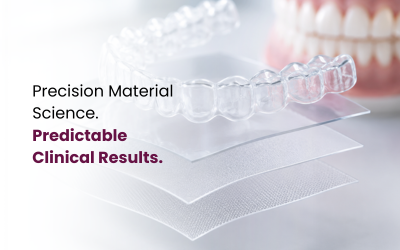
Tri-Layer Architecture: Assigning Each Function to the Right Material
Multi-layer aligner construction solves the single-layer trade-off by architectural separation of function. Each clinical requirement is assigned to the layer best suited to meet it:
- Optical clarity, stain resistance, and surface aesthetics → PCTG outer layer
- Sustained force delivery, force modulation, and insertion comfort → TPU middle core
- Structural strength, shape stability, and long-term dimensional accuracy → PCTG inner layer
The resulting performance envelope is not achievable with any single material. It is a designed system property that emerges from the combination of materials in the correct structural relationship.
Architecture and Materials
ClearPath Clarix uses a precisely engineered three-layer structure in a 30:40:30 ratio:
Outer Layer — 30% PCTG (ClearQuartz) ClearPath’s branded outer layer material. ClearQuartz is a low-porosity PCTG formulation that delivers superior optical clarity, documented stain resistance (tested against coffee and mustard, common clinical reference standards), and a surface finish that maintains its aesthetic properties across the full aligner wear cycle. ClearQuartz outer layers are four times more tear-resistant than conventional single-layer polymers, a function of both material selection and the structural reinforcement provided by the Tri-Layer sandwich construction.
Middle Layer — 40% TPU The clinical core of the Clarix system, and the component that most directly differentiates its force delivery profile from single-layer alternatives. The 40% proportion reflects the primary clinical contribution of this layer: sustained, consistent force modulation across the tray wear period. This is the layer that reduces tracking variance and drives more predictable stage-to-stage progression.
Inner Layer — 30% PCTG (ClearQuartz) The structural foundation of the aligner, in direct contact with tooth surfaces throughout treatment. The inner ClearQuartz layer maintains the aligner’s dimensional accuracy against occlusal load, providing the precise spatial relationship between the tray and the target tooth position that controlled movement requires.
Advanced Clinical Manufacturing
Material selection and architectural design are realized clinically only through precise manufacturing execution. Every ClearPath Clarix aligner is produced through a six-step advanced manufacturing process in ClearPath’s DRAP-Approved facility:
- Advanced thermoformers — calibrated to the Tri-Layer material specification for consistent layer integrity across the full aligner surface
- Controlled anterior thinning — programmed reduction of anterior section thickness to optimize the aesthetics-to-strength balance in the highest visibility region
- Uniform ceramic heating — even thermal application across the material surface eliminates differential material properties that arise from localized hot or cold zones during forming
- CNC-based automated finishing — computerized trimline definition eliminates the dimensional variability inherent in manual finishing, producing reproducible edge geometry across every unit
- Automated gingival trimlines — scalloped performance trimlines positioned consistently at the gingival margin, reducing soft tissue irritation and improving patient retention
- Automated sterile packaging — contaminant-free release from the DRAP-licensed facility to your clinic
Every set undergoes documented quality inspection before release, with complete traceability from the patient prescription and digital treatment plan back through manufacturing records and raw material batch — a DRAP regulatory requirement.
Manufacturing Precision That Supports Clinical Precision
ClearPath manufactures to 50 microns precision. For context: the typical movement programmed per aligner stage is in the range of 0.15 to 0.25 mm. Manufacturing variation at the 50-micron level represents a clinically meaningful margin of accuracy, it means the aligner you receive is fabricated to the treatment plan your patient’s case demands, not to a close approximation of it.
Combined with a 48-hour turnaround from case submission to aligner dispatch, the manufacturing process supports the clinical workflow your practice needs rather than creating logistical delays that extend overall case timelines.
What Clarix Delivers Clinically
The combination of Tri-Layer material engineering and advanced manufacturing produces clinical outcomes that matter directly to your practice:
Controlled tooth movement — force is applied within a dimensionally stable structure that maintains the target geometry throughout the wear period. Planned movement per stage is more consistently achieved.
Consistent force over time — the TPU middle core maintains effective force delivery across the full tray cycle. The last three days of a 10-day tray are as therapeutically active as the first three.
Improved tracking accuracy — shape stability from the ClearQuartz inner layer and consistent force from the TPU core reduce the position deficits that accumulate into tracking failures. Your cases track closer to the simulation.
Low insertion force — the elastomeric middle layer reduces the seating force required for each new tray, improving the patient experience at each stage change and supporting consistent wear compliance.
Fewer refinements — consistent force delivery and improved tracking together reduce the refinement aligner sets required per case. Across a caseload, this compounds into meaningful practice efficiency.
Enhanced crack resistance — the TPU elastomeric middle layer absorbs mechanical energy that propagates as cracks through fully rigid single-layer constructions. Aligners last their prescribed wear period without structural failure.
More predictable case completion — everything above produces the outcome your treatment simulation promised: cases that track reliably, reach their endpoints closer to the planned timeline, and require fewer unplanned clinical interventions.
Read More: ClearPath RoadShow – Lahore Edition
The ClearPath Clinical Ecosystem
Clarix aligners are the clinical centrepiece of a broader partner ecosystem designed to support your practice workflow from case assessment through retention.
CP Smart 2.0 — AI-Powered Treatment Planning
CP Smart 2.0 is ClearPath’s AI-powered planning platform, developed in-house. It simulates tooth movement before treatment begins, improves treatment precision, shortens treatment time, and minimises refinements. You retain full control from initial smile simulation through to case modification and final approval — the platform enhances your clinical judgment; it does not replace it.
Dentists’ Portal — Practice Workflow Integration
The all-in-one Dentists’ Portal manages your case submissions, progress tracking, and interactive case dashboard in a single workflow. Simplified billing and fast tracking are built into the portal. From digital scan submission to aligner dispatch and case completion, the portal gives you visibility across your entire ClearPath caseload.
Regulatory Confidence at Every Stage
ClearPath Clarix is DRAP approved, FDA 510(k) cleared, and manufactured in Pakistan’s only DRAP-Approved clear aligner facility. It also holds international regulatory recognition from MHRA (UK), TGA (Australia), Health Canada (Canada), Medsafe (New Zealand), Infarmed (Portugal), and Läkemedelsverket (Sweden) — making it one of the most comprehensively credentialed aligner products available anywhere in the region.
For your practice, prescribing a DRAP and FDA 510(k)-cleared aligner from a DRAP-Approved manufacturer means your material claims are backed by documented regulatory review, not marketing assertions.
Material is BPA-free and stain-free, with biocompatibility evidence in accordance with ISO 10993. HIPAA and GDPR compliance covers patient data handled through the Dentists’ Portal.
Training and Education
ClearPath provides structured continuing education through certified training courses, including Clear Aligner Technology Training and Certification, Advanced Clinical Pathways in Clear Aligner Therapy, and Advanced Strategies in Clear Aligner Orthodontics. Courses are offered at partner institutions including Baqai Dental College Karachi, SZABMU Islamabad, and Talha Medical Larkana. Check clearpathortho.com for current course schedules and registration.
ClearPath Clarix vs Single-Layer Aligner Systems: Clinical Summary
| Clinical Factor | Single-Layer PETG | Single-Layer PCTG | ClearPath Clarix Tri-Layer |
|---|---|---|---|
| Force delivery profile | High spike, rapid decay | Moderate decay | Sustained, consistent |
| Tracking accuracy | Variable | Better | Improved |
| Clarity maintenance | Declining | Good | High – ClearQuartz surface |
| Stain resistance | Moderate | Good | High |
| Crack resistance | Moderate | Good | Enhanced |
| Patient comfort at tray change | Moderate | Moderate | High – low insertion force |
| Refinement frequency | Higher | Moderate | Reduced |
| DRAP approval (Pakistan) | Varies | Varies | Yes – Pakistan’s only approved brand |
| International regulatory coverage | Varies | Varies | FDA 510(k), MHRA, TGA, Health Canada, Medsafe |
| Manufacturing precision | Varies | Varies | 50 microns |
| Turnaround time | Varies | Varies | 48 hours |
Conclusion: Material Science Is Clinical Science
The material inside a clear aligner is not an abstraction. It is the mechanism by which the forces your treatment plan specifies are delivered to your patient’s teeth, maintained throughout the wear period, and translated into the tooth movement that produces the clinical result.
PETG remains the most common aligner material because it is economical and processable. For practices that want to compete on clinical outcomes rather than commodity pricing, it has measurable limitations.
PCTG’s superior stain resistance, dimensional stability, and impact resistance make it the appropriate structural layer for a high-performance aligner.
TPU’s elastomeric force profile – sustained, graduated, and consistent – addresses the fundamental biomechanical limitation of rigid single-layer design.
ClearPath Clarix brings all three material advantages together in a 30:40:30 Tri-Layer architecture, manufactured to 50-micron precision in a DRAP-licensed facility with 48-hour turnaround, backed by 20+ years of manufacturing experience, 300,000+ treated cases, and regulatory approval across eight international markets.
For dental professionals who want predictable cases, fewer refinements, and a regulated manufacturing partner committed to your practice growth — this is the clinical choice.
Join 10,000+ certified dentists across 26+ countries who have made ClearPath their No. 1 clear choice.
Register as a ClearPath certified provider at clearpathortho.com/partner-with-us