
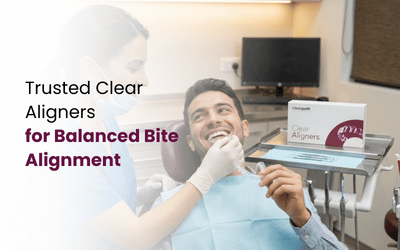
Trusted Clear Aligners
for Balanced Bite Alignment
Podcast on this blog is available now! →
How ClearPath Aligners Improve Bite Alignment
The field of orthodontics has undergone a profound transformation. In 2026, the primary metric for success is no longer just “straight teeth,” but the optimization of functional health. Modern practitioners now focus on how advanced thermoplastic systems can improve bite alignment to ensure long-term occlusal stability and prevent dental morbidity. ClearPath Orthodontics, a pioneer since 2007, leads this shift by integrating artificial intelligence with biomechanical precision to correct complex malocclusions.
A healthy smile requires a harmonious relationship between the maxillary (upper) and mandibular (lower) arches. Misalignments—such as overbites, underbites and crossbites—are more than aesthetic concerns. They are precursors to significant issues, including premature enamel wear, temporomandibular joint (TMJ) disorders and chronic myofascial pain. ClearPath aligners provide a medically supervised, non-invasive solution that addresses these fundamental issues through custom-engineered trays.
Understanding Malocclusion: The First Step to Improve Bite Alignment
Malocclusion is defined as any deviation from the ideal relationship of the dental arches. To effectively improve bite alignment, a clinician must first distinguish between dental issues (tooth positioning) and skeletal issues (jaw structure).
1. Overbite and Overjet (Class II Malocclusion)
An overbite happens when the upper front teeth cover too much of the lower teeth. In severe cases, this can cause the lower teeth to press against the roof of the mouth, leading to discomfort and sensitivity.
Overjet: Often confused with an overbite, an overjet is a horizontal discrepancy where the upper teeth protrude forward (“buck teeth”).
ClearPath Solution: To improve bite alignment in these cases, ClearPath uses intrusion of anterior teeth and elastics to retract the upper arch while leveling the occlusal plane.
2. Underbite (Class III Malocclusion)
An underbite, or prognathism, occurs when the lower teeth sit in front of the upper teeth. This condition significantly impacts speech and masticatory function, often causing the lower jaw to appear overly prominent.
Clinical Impact: Underbites place excessive stress on the TMJ as the jaw shifts to compensate for the misalignment.
ClearPath Solution: Treatment often involves expanding the upper arch and using Class III elastics to move the lower teeth posteriorly, rejuvenating the facial profile.
| Malocclusion Type | Primary Symptoms | Clinical Goal |
| Overbite | Vertical overlap, palatal trauma | Intrude front teeth, level the bite |
| Underbite | Lower teeth protrude, speech lisp | Reposition mandibular arch |
| Crossbite | Upper teeth sit inside lower teeth | Arch expansion and buccal tipping |
| Overjet | Horizontal protrusion | Anterior retraction via elastics |
The Biomechanics of Push Force: How ClearPath Systems Improve Bite Alignment
Clear aligner therapy is a feat of biological engineering. Unlike traditional braces that “pull” teeth using wires, ClearPath aligners utilize a “push” mechanism. This mechanism encases the entire clinical crown, applying directed force vectors to trigger the bone remodeling process.
Cellular Signaling and Bone Remodeling
To improve bite alignment, aligners must stimulate the periodontal ligament (PDL). When a tray applies pressure, it creates two distinct environments :
Compression Zone: Where the root is pushed against the bone, blood flow is restricted. This recruits osteoclasts—cells that resorb bone to make a pathway for movement.
Tension Zone: On the opposite side, the PDL fibers stretch, stimulating osteoblasts to deposit new bone matrix, stabilizing the tooth in its new position.
The Digital Workflow: From 3D Scans to Targeted Movement
The accuracy of ClearPath treatment is rooted in its 2026 digital ecosystem. Every step of the workflow is designed to eliminate the errors inherent in manual impressions.
3D Intraoral Scanning: Using the Planmeca Emerald S scanner, doctors capture exceptionally fine detail, creating a high-resolution digital twin of the patient’s anatomy.
CP Smart™ AI Planning: Proprietary software analyzes the scan against a global database of successful cases. The AI predicts how each tooth will respond to force, creating an optimal movement sequence.
Treatment Setup Preview: Before manufacturing, patients can view a 3D simulation of their journey. This “visual roadmap” shows the before-and-after of how the aligners will improve bite alignment.
Computer-Crafted Manufacturing: Once approved, the aligners are produced using multi-layered polymer engineering and precise 3D printing.
Safety First: FDA and DRAP Approved Aligner Materials
In a market crowded with “direct-to-consumer” kits, regulatory oversight is the primary safeguard for patient health. ClearPath distinguishes itself as the first brand in Pakistan to hold both FDA 510(k) clearance and DRAP approval.
Biocompatibility and ISO 10993 Standards
Because aligners are in contact with oral mucosa for extended periods, the material must be non-toxic and hypoallergenic . ClearPath aligners undergo rigorous ISO 10993 testing, which includes :
Cytotoxicity (ISO 10993-5): Ensures materials do not cause cell death .
Sensitization and Irritation (ISO 10993-10): Confirms the plastic does not trigger allergic or inflammatory responses .
Genotoxicity (ISO 10993-3): Evaluates whether chemicals could cause genetic damage over long-term exposure .
These certifications ensure that when you use ClearPath to improve bite alignment, you are using medical-grade appliances that are safe for your oral environment.
By 2050, the industry will move toward “Adaptive Orthodontics,” where treatments are dynamic and fully integrated with digital lives .
Direct 3D Printing (DPAs): Future aligners will likely be printed directly rather than thermoformed over molds . This allows for variable thickness within a single tray—rigid for anchorage and flexible for movement.
Shape-Memory Polymers (SMPs): “Smart” materials will change properties based on mouth temperature, delivering programmable force over time. This could reduce the number of trays needed per case.
Predictive Controllers: AI will act as a real-time “predictive controller,” adjusting the next set of aligners based on data from intraoral sensors or smartphone photos.
Clinical and Lifestyle Advantages: ClearPath vs. Traditional Braces
While metal braces remain the “gold standard” for severe skeletal surgery cases, clear aligners are the preferred choice for most adults and teens in 2026.
Hygiene and Periodontal Health
Removability is the single greatest clinical advantage. Patients can brush and floss normally, avoiding the plaque traps and “white spot lesions” (decalcification) common with metal brackets. This makes aligners a periodontal-friendly choice for those with a history of gum disease.
Aesthetic Freedom and Comfort
ClearPath aligners are nearly invisible, allowing professionals and self-conscious teens to undergo treatment without the “metallic shine” of braces. The smooth, scalloped edges prevent the mouth sores and irritation caused by wires.
Read More: How to Manage Clear Aligners While Fasting
Conclusion: A Future-Ready Smile
Choosing to improve bite alignment with ClearPath Orthodontics is an investment in both aesthetic beauty and lifelong functional health. Through the synergy of AI-driven CP Smart™ planning, medical-grade biocompatible materials and a strong global presence in over 26 countries, ClearPath provides a safe and predictable journey to your target smile.
By adhering to the highest global safety standards (FDA and DRAP), ClearPath ensures that your transformation is clinically sound and life-changing. Whether you are a patient seeking a discreet solution or a practitioner demanding precision, ClearPath remains the definitive authority in modern orthodontic care.
Read More: Why Dentists Are Switching to Clear Aligners