
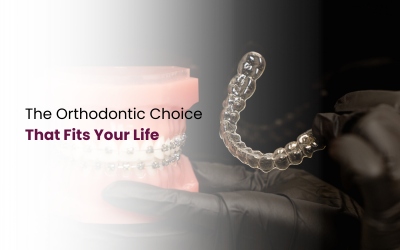
The Orthodontic Choice
That Fits Your Life
Clear Aligners vs Braces: Which Looks Better in Public?
Here is something nobody tends to say out loud: a significant part of choosing orthodontic treatment is about how you will look and feel on an ordinary Tuesday. Not at the end of treatment, when the results speak for themselves — but during it. At the coffee shop, in the meeting room, across the dinner table. That in-between period, which can last anywhere from six months to two years, is the part that most comparison articles skip over entirely. This one does not. Whether you are weighing up clear aligners vs braces for the first time or trying to make a final decision, what follows is a genuinely different look at the question.
Read More: Pakistan’s First DRAP Approved Clear Aligner
The Question Nobody Asks Directly — But Everyone Thinks About
When people search for information on braces vs aligners, they are usually looking for clinical comparisons: effectiveness rates, treatment times, which one fixes overbites better. All of that matters, of course. But tucked behind the technical questions is a much more personal one: how will I feel about myself while I am doing this?
It is a completely reasonable thing to think about. Orthodontic treatment is not a weekend procedure — it is a months-long commitment that unfolds across your actual life. Job interviews happen during treatment. First dates happen. Family weddings, work conferences, school reunions. The idea that appearance during treatment is somehow a vanity concern, separate from the serious clinical stuff, is frankly a bit out of touch with how people actually live.
This is why the rise of clear aligners — sometimes referred to loosely as invisible braces in everyday conversation — has been so significant. Not because they replaced traditional braces for every patient or every case, but because they gave people a way to straighten their teeth without feeling like their orthodontic treatment was the first thing anyone noticed about them.
What Your Mouth Is Actually Doing in Public — And Why It Matters
Think about how many social and professional interactions involve your face, your smile, and the lower half of your expression. Presentations, conversations, laughter, photographs, video calls. Research in social psychology consistently shows that we make rapid, largely unconscious judgements about people within seconds of meeting them — and that smile and dental appearance feature heavily in those first impressions.
This is not about vanity. It is about the reality of human interaction. Metal braces, while completely effective from a clinical standpoint, carry a strong visual association in most cultures with early adolescence. For an adult wearing them, this can sometimes create an unconscious disconnect — a mismatch between how old you are, how you carry yourself professionally, and what people see when you open your mouth to speak.
Clear aligners sidestep this entirely. Because the trays are transparent and fit flush against the teeth, most people simply do not notice them. You can speak, laugh, and present without any of that quiet self-consciousness. That might sound like a small thing until you are sitting in a job interview thinking about whether to smile.
The Psychology of Wearing Orthodontic Treatment in Public
There is a reasonably well-documented phenomenon in psychology sometimes called self-objectification — the way we begin to monitor our own appearance through the imagined eyes of other people, particularly in social settings. Orthodontic treatment can amplify this. Patients with highly visible braces often report becoming more guarded with their smiles, covering their mouths when they laugh, or feeling reluctant to speak up in group settings.
This is especially common among adults undertaking treatment in professional environments. In a 2022 study published in the European Journal of Orthodontics, adult patients reported that the social visibility of their orthodontic appliance was one of the top factors affecting their quality of life during treatment — rating it as important as physical discomfort in many cases.
Clear aligners for social confidence are not a gimmick or a marketing line. For many adults, the ability to continue presenting professionally and socially without a visible appliance genuinely changes how they experience the treatment period. They are not constantly reminded that they are in treatment. They can focus on the conversation rather than how they look while having it.
Five Real-Life Settings Where the Difference Between Braces and Aligners Is Very Clear
1. The Workplace
Whether you are in a client-facing role, work in education, lead teams, or simply attend regular meetings, how you present yourself matters. For adults considering teeth straightening without braces in the traditional sense, the workplace is often the deciding factor. With clear aligners, colleagues are unlikely to notice anything different unless you tell them. With metal braces, it tends to come up — sometimes in light-hearted ways, but it is never entirely invisible as a topic.
2. Video Calls
Remote work has made video calls a central part of professional life, and the camera tends to zoom in on exactly the part of your face you might prefer to keep unnoticed. Metal brackets and wires are clearly visible on screen. Clear aligner trays, especially with good lighting, are far less obvious. For anyone spending hours a day on camera, this is a practical consideration, not an abstract one.
3. Social Events and Celebrations
Weddings, milestone birthdays, reunions — these are the events people tend to be photographed at most. Nobody wants to look back at photographs from a significant occasion and see metal hardware dominating their smile. Clear aligners can be removed for photographs if necessary, and even when worn, they are largely undetectable in most lighting conditions.
4. Dating and Relationships
This is the topic most orthodontic articles dance around, but it is a real consideration for adults. Dating involves proximity, close conversation, and a significant amount of self-awareness. Adults who start orthodontic treatment while single often cite appearance during treatment as a genuine concern. Transparent braces for adults, in this context, offer something that metal braces simply cannot: the ability to show up on a first date without the appliance being part of the conversation.
5. Public Speaking
For teachers, lecturers, salespeople, presenters, or anyone who regularly speaks to groups of people, diction and confidence are inseparable. Metal braces can occasionally affect speech slightly during the adjustment period, and they are clearly visible to an audience. With clear aligners, the occasional mild lisp in the first few days is the only adaptation required — and it resolves quickly for most people.
Clear Aligners Benefits: What Goes Beyond the Obvious
Most articles list the benefits of clear aligner treatment — they are removable, discreet, comfortable. All true. But there are a handful of less-discussed advantages that are worth knowing about:
- Treatment does not have to pause your life. With traditional braces, there is a meaningful adjustment period after each tightening appointment — soreness, tenderness, and heightened self-consciousness. With aligners, you move to a new tray at home, on your own schedule, with minimal disruption.
- Oral health does not take a back seat. Brushing and flossing around brackets and wires is genuinely difficult, and many patients finish a course of braces with some degree of enamel decalcification or gum inflammation. Removable aligners mean you can maintain exactly the oral hygiene routine you had before treatment started.
- You can see where you are going. Modern aligner systems use digital 3D planning to map out the full course of tooth movement before treatment begins. Many patients can preview a simulation of their expected result — something traditional braces cannot offer in the same way. Knowing what the end result should look like makes the process feel less uncertain.
- Social meals stay social. With metal braces, dining out involves a degree of anxiety — foods to avoid, things that get stuck, the post-meal bathroom check. With aligners, you remove the trays before eating and put them back afterwards. That is it. Dinner stays pleasant.
- The finish tends to feel cleaner. At the end of braces treatment, the removal of brackets can sometimes reveal patches of discoloration or sensitivity. Because aligners do not bond to the tooth surface, there is no equivalent experience — the teeth at the end of treatment are the same surface they were at the beginning.
What a Well-Designed Clear Aligner Treatment Actually Looks Like
Not all aligner systems are the same, and it is worth understanding what a high-quality treatment programme includes — especially since some direct-to-consumer aligner products have blurred the lines between supervised orthodontic care and a mail-order product.
A properly managed clear aligners treatment programme should include:
- A thorough clinical assessment by a qualified orthodontist or dentist, including dental X-rays and either physical impressions or digital 3D scans, to determine whether your case is suitable for aligner treatment.
- A digital treatment plan that maps out the precise sequence of tooth movements, the number of trays required, and the projected timeline.
- Custom-fabricated trays made from medical-grade, BPA-free thermoplastic material and precision-trimmed to follow the gum line for comfort.
- Regular monitoring appointments at appropriate intervals throughout treatment to check that teeth are tracking as planned and to address any deviations early.
- Attachments where clinically necessary. These are small tooth-coloured composite bumps bonded to specific teeth to help the aligner achieve more complex movements. In a well-designed system they are used thoughtfully and remain relatively inconspicuous.
- Retention after active treatment. A set of retainer trays worn at night to maintain the result long-term — because without retention, all orthodontic treatment, braces or aligners, has a tendency to relapse over time.
ClearPath’s approach, as a manufacturer and treatment system, is built around clinician oversight rather than bypassing it. The aligners are fabricated using advanced digital processes and distributed through trained dental professionals — which is a meaningful distinction from unsupervised at-home aligner kits.
Pros and Cons: An Honest Side-by-Side
Clear Aligners | Traditional Metal Braces |
|---|---|
ADVANTAGES | ADVANTAGES |
Nearly invisible in everyday situations | Highly effective across a wider range of complex cases |
Removable for eating, drinking, and special occasions | Fixed to the teeth — no compliance issue with wear time |
No dietary restrictions during treatment | Generally lower cost in many markets |
Comfortable fit with no sharp brackets or wires | Suitable for children and teenagers who may not manage removable trays reliably |
Oral hygiene is straightforward throughout treatment | No risk of losing or forgetting to put them back in |
Allows preview of expected result via digital planning | Widely available from most orthodontic practices globally |
LIMITATIONS | LIMITATIONS |
Requires genuine discipline — 20 to 22 hours of wear daily without exception | Clearly visible throughout treatment — brackets, wires, and ligatures |
Not ideal for very severe malocclusions or significant skeletal discrepancies | Dietary restrictions — hard, sticky, and chewy foods must be avoided |
Trays can be lost or damaged, and replacements take time | Mouth sores and ulceration are common, particularly in the early weeks |
A slight lisp is possible in the first few days with each new tray | Brushing and flossing around fixed brackets is time-consuming and often incomplete |
Results depend on patient compliance more than braces do | Discomfort after tightening appointments can last several days |
So Who Should Actually Choose Clear Aligners?
The honest answer is: not everyone, and any provider who tells you otherwise is not giving you good clinical advice. Clear aligner treatment works extraordinarily well for a broad range of cases — mild to moderate crowding, spacing, and certain bite issues — but there are cases where traditional braces are genuinely the better clinical choice, and no amount of lifestyle preference changes that.
Where clear aligners tend to work best is when the patient is an adult or older teenager, their orthodontic issue falls within the treatable range for their chosen aligner system, and — critically — they are honest with themselves about compliance. The treatment only works if you wear the trays. Adults who travel frequently, have demanding social schedules, or know they tend to lose or misplace things should factor that in.
For the right patient, though, the combination of clinical effectiveness and social discretion makes clear aligners a compelling choice — particularly when they are part of a professionally supervised, customised orthodontic treatment programme rather than an unsupervised kit ordered online.
ClearPath Orthodontics designs its aligner systems specifically around clinician-led treatment. Every case goes through a qualified dental professional, and the aligners themselves are manufactured to a standard that reflects the precision required for predictable tooth movement. That distinction matters.
The Conclusion Worth Actually Reading
Most comparison articles about braces and aligners end with a variation of: “both options have merit, speak to your dentist.” That is technically true but not particularly useful. So here is a more direct take.
If your case is clinically suitable for aligner treatment, and you are an adult who cares about how you present yourself in public — at work, in social settings, on camera, in photographs — then clear aligners are almost certainly the better choice for your quality of life during treatment. Not because traditional braces are inferior as an orthodontic tool, but because the treatment period is long, you live your actual life during it, and how you feel about yourself during those months is not a trivial consideration.
The comparison between clear aligners vs braces is not only a clinical question. It is also a question about what kind of experience you want to have on the way to the result. For most adults, that experience — discreet, comfortable, manageable, and fitted around real life rather than the other way around — is something clear aligners deliver in a way that traditional braces simply do not.
If you would like to explore whether clear aligner treatment is right for you, ClearPath Orthodontics offers clinician-led, customised orthodontic solutions through trained dental professionals. You can learn more at clearpathortho.com.
FAQs
1. Do clear aligners really stay invisible when you speak?
For the vast majority of people in everyday social situations, yes. The trays are transparent and sit flush against the tooth surface, so they do not catch the light or distort the outline of your teeth the way a visible appliance would. In very bright lighting or during close inspection, a faint outline may be detectable — but in normal conversation, most people will not notice them at all.
2. Is there any difference in how long clear aligner treatment takes compared to braces?
Treatment time varies enormously depending on the complexity of the case, so it is difficult to generalise. For mild to moderate cases that are well-suited to aligners, treatment timelines are broadly comparable to braces. Where aligners sometimes fall short is in complex cases that require very precise tooth-by-tooth control — these may take longer with aligners than they would with fixed appliances, or may simply be better managed with braces from the outset.
3. Can I take the aligners out for an important event or meeting?
Yes — this is one of the genuine advantages of the system. You can remove the trays for a presentation, a wedding, a formal dinner, or any occasion where you prefer not to be wearing them. The trade-off is that every hour out of the trays is time not spent in treatment, so if you are consistently removing them for hours at a time, your progress will slow. The 20 to 22 hour daily wear recommendation exists for a reason.
4. Do clear aligners affect speech in the long term?
No. The most common speech effect is a mild sibilant lisp — a slight softening of ‘s’ and ‘sh’ sounds — in the first few days after starting a new tray. For most people this resolves within two or three days as the tongue adapts. There is no permanent speech effect associated with clear aligner treatment when the trays fit correctly.
5. Why are some at-home aligner kits cheaper, and should I consider them?
Direct-to-consumer aligner kits that bypass in-person clinical assessment carry real risks. Without X-rays, a proper bite assessment, and ongoing monitoring, tooth movement can proceed in ways that are clinically unsound — leading to root damage, bone loss, or a result that requires more extensive correction later. The lower cost reflects the absence of professional oversight, not a more efficient manufacturing process. Professionally supervised aligner treatment through a qualified provider is the clinically responsible route.
6. What happens after treatment ends — do I need to wear something permanently?
Yes, and this applies to all orthodontic treatment regardless of method. Once active treatment ends, teeth have a natural tendency to shift back towards their original positions over time. A retainer — typically a thin tray worn at night — is what keeps the result stable. This is not a sign that treatment has failed; it is simply the biological reality of tooth movement. Skipping retention is the most common reason patients find their teeth have shifted years after treatment.
7. How do I know if my case is suitable for clear aligners?
The only reliable way to know is through a proper clinical assessment with a qualified orthodontist or dentist. A thorough examination, including dental imaging, allows your clinician to assess the nature and severity of your orthodontic issue and advise you honestly on whether aligners are appropriate. If you are based in Pakistan or the surrounding region, ClearPath works through a network of trained dental professionals who can carry out this assessment and walk you through your options.