
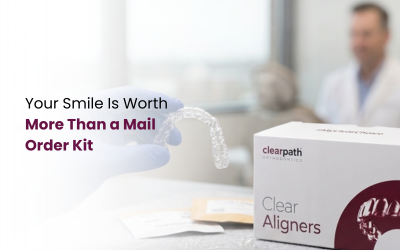
Your Smile Is Worth
More Than a Mail-Order Kit
Thinking of Skipping the Orthodontist for Aligners - Read This First
The adverts make it look so simple. Upload a photo, take an impression at home, receive your aligners in the post, and start straightening your teeth – no clinic visits, no waiting rooms, no professional fees. It sounds like a smarter, faster, more convenient way to do things. And honestly? It is easy to see why people are tempted. But here is the question that the advertising never quite answers: what is actually being skipped when you skip the orthodontist? Because it is not just a formality. It is the part that keeps the process safe.
Read More: Pakistan’s First DRAP Approved Clear Aligner
Ordering Aligners Online? Here is What the Process Is Actually Missing
When you visit an orthodontist before starting aligner treatment, several things happen that cannot be replicated through a selfie or a home impression kit. Your clinician takes X-rays — not to look at your teeth, but to assess the bone and roots underneath them. They check for existing gum disease, cavities, and bite issues that could be made significantly worse by moving teeth in the wrong sequence. They map the relationship between your upper and lower jaw.
None of this is visible from the outside. None of it shows up in a photograph. And none of it is assessed in a typical mail-order aligner process.
Moving teeth without knowing what is happening beneath the gum line is not just ineffective — it can cause damage that takes far longer and costs far more to correct than the original problem ever would have.
This is the central issue with DIY teeth aligners and the risks they carry. It is not that the plastic is poor quality or that the trays are uncomfortable. It is that the treatment plan itself is built without the clinical information needed to make it safe.
The Damage That Happens Quietly - Before You Even Realise It
Problems with unsupervised aligner treatment often do not announce themselves immediately. This is part of what makes them so insidious. You might be three or four months into a course of at-home aligners, feeling like things are progressing, before any sign of a problem becomes visible. By that point, damage may already have occurred.
Here are the specific risks that clinical professionals flag most consistently:
- Root resorption. When teeth are moved too quickly or in the wrong direction, the roots can shorten — a process that is irreversible and that weakens the long-term stability of the affected teeth.
- Bone loss around the teeth. Mismanaged tooth movement can compromise the alveolar bone — the bone that holds your teeth in place. This kind of damage is not corrected by simply stopping the treatment.
- Worsening of bite problems. Some bite issues, left undiagnosed, are made considerably worse by moving teeth without addressing the underlying jaw relationship first.
- Gum recession. Moving teeth outward beyond the natural boundary of the bone can pull the gum tissue away from the root surface. This is not cosmetically fixable without periodontal treatment.
- Relapse without proper retention planning. Every properly managed aligner treatment ends with a retention plan. Mail-order systems rarely include this adequately, and without retention, teeth move back — sometimes faster than they were corrected.
The Cheaper Option That Ends Up Costing More
The price difference between an at-home aligner kit and a professionally supervised treatment is real, and it would be dishonest to pretend otherwise. At-home options are cheaper upfront. That is a fact.
But the calculation changes entirely once you factor in what happens when something goes wrong. Correcting root resorption is not straightforward. Treating bone loss requires periodontal intervention. Addressing bite problems that were aggravated by unsupervised treatment often involves more extensive and more expensive orthodontic work than the original case would have needed.
So the real question is not “can I afford professional treatment?” The question is: “can I afford the consequences of getting it wrong?”
Affordable clear aligner treatment in Pakistan does not have to mean unsupervised treatment. Clinician-led options are more accessible than most people assume, particularly through providers like ClearPath, who work through trained dental professionals to keep costs reasonable without compromising on clinical oversight.
What Safe, Professionally Guided Aligner Treatment Actually Looks Like
The process is simpler than most people expect. Here is what actually happens.
Step 1: Clinical Assessment
A qualified orthodontist or dentist examines your teeth, gums, and bite. Dental X-rays are taken. Any existing issues such as cavities, gum inflammation, bite discrepancies are identified and addressed before treatment begins. This step alone eliminates a significant proportion of the risks associated with DIY approaches.
Step 2: Digital Treatment Planning
3D scans are used to map exactly how each tooth will move and when. With ClearPath, clinicians review and approve every stage before a single aligner is made.
Step 3: Custom Aligner Fabrication
Every tray is custom-made for your teeth. The fit and material quality are not cosmetic details — they determine whether the treatment actually works.
Step 4: Ongoing Monitoring
This is the step that at-home aligner systems simply cannot replicate. Teeth do not always move as planned. A clinician monitoring your progress is what catches that early — before it becomes a real problem.
Step 5: Retention
At the end of active treatment, a proper retention plan is put in place. For most patients, this means wearing retainer trays at night indefinitely. It is not optional, and it is not a minor afterthought, it is the part of treatment that keeps the result stable for years.
A Note for Patients in Lahore and Across Pakistan
There is a particular context worth addressing directly here. In Pakistan – and in Lahore specifically – the market for online and at-home dental products has grown significantly, partly because access to quality orthodontic care has historically been seen as expensive or difficult to find. That perception is increasingly outdated.
ClearPath Orthodontics, based in Lahore, works through a network of trained dental professionals across Pakistan to provide clinician-supervised clear aligner treatment at pricing that is designed to be genuinely accessible. The aligners are FDA and DRAP-approved and manufactured to the same standards as internationally distributed systems. The treatment is supervised, the planning is digital, and the oversight is real.
If you are looking for safe aligners in Lahore, or a teeth straightening clinic in Lahore that offers a guided, affordable route to treatment, the starting point is a proper consultation and not a kit ordered online. The difference in cost is smaller than most people expect. The difference in safety is not.
End Note
The appeal of ordering aligners online is completely understandable – lower cost, no appointments, convenience. But orthodontic treatment is not a product. It is a clinical process that involves moving the roots of your teeth through living bone, and the outcome depends entirely on whether that process is planned and monitored by someone who can actually see what is happening beneath the surface.
The orthodontist is not an optional add-on to aligner treatment. The orthodontist is the part that makes aligner treatment safe.
If you are considering teeth straightening and want to do it properly — with clinical oversight, DRAP-approved materials, and a treatment plan built around your specific case — ClearPath Orthodontics is a good place to start. Visit clearpathortho.com to find a trained provider near you.
FAQs
1. Is the Danger of At-Home Aligners Real, or Overstated?
The risks are real and documented — but they are silent risks. Root resorption and bone loss do not hurt. They do not show up in a mirror. By the time you notice something is wrong, significant damage may already have been done.
2. What is the actual difference between a mail-order aligner and one from a clinic?
The plastic tray itself may look identical. The difference is everything that surrounds it: the clinical assessment before treatment starts, the personalised treatment planning, the professional monitoring throughout, and the retention management at the end. A tray without a proper plan behind it is not a treatment – it is just a piece of shaped plastic.
3. Can I get affordable clear aligner treatment in Pakistan without compromising on safety?
Yes. Affordability and clinical oversight are not mutually exclusive. ClearPath works specifically to make supervised aligner treatment accessible in Pakistan through a network of trained providers. DRAP approval means the product meets a defined regulatory standard. The cost of a properly supervised treatment through a ClearPath provider is not comparable to a private specialist clinic abroad, it is designed for the local market.
4. How do I know if my case is even suitable for aligners?
You cannot know without a clinical assessment and neither can the aligner company, regardless of what their online questionnaire suggests. Suitability depends on the type and severity of your orthodontic issue, the health of your gums and bone, and your bite relationship. A qualified professional can tell you within a single consultation whether aligners are the right approach for your specific case or whether a different option would serve you better.
5. What should I look for when choosing an orthodontist or dental clinic for aligners in Lahore?
Look for a clinic that uses a proper digital planning process rather than a one-size-fits-all approach, that takes dental X-rays before starting treatment, and that has clear protocols for monitoring your progress throughout. Ask specifically whether the aligners they use are DRAP-approved, in Pakistan, this is the relevant regulatory standard. ClearPath-affiliated providers meet all of these criteria, and the network spans multiple cities.
6. What happens if I have already started an at-home aligner course and I am worried?
Stop wearing the trays and see a dentist as soon as you can. Do not wait until the course is finished. A clinical examination, including X-rays, will tell your dentist whether any damage has occurred and what the appropriate next steps are. The earlier a problem is caught, the more manageable it is.