
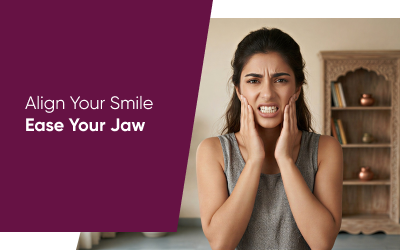
Align Your Smile
Ease Your Jaw
Podcast on this blog is available now! →
The Relationship Between Misaligned Teeth and Jaw Pain
Orthodontics today goes far beyond straightening teeth for cosmetic reasons. It has evolved into a precise, digitally driven discipline focused on improving function, comfort, and long-term oral health. One of the most commonly overlooked consequences of misaligned teeth is jaw pain. Many individuals experience persistent discomfort, stiffness, or clicking in their jaw without realizing that the underlying issue may be their bite. When teeth are not properly aligned, the entire system of the mouth is affected. The way your upper and lower teeth meet plays a critical role in how forces are distributed across your jaw. Any imbalance in this system can lead to excessive strain on the joints and muscles. With advancements in digital orthodontics and clear aligners, these issues can now be diagnosed and treated with greater accuracy, offering patients a modern and comfortable solution.
Read More: Why Dentists Are Switching to Clear Aligners
What Are Misaligned Teeth?
Misaligned teeth, also known as malocclusion, occur when teeth are not positioned correctly within the dental arches or do not align properly with opposing teeth.
In a healthy bite, teeth fit together in a way that allows smooth movement during chewing and speaking. Forces are evenly distributed, and the jaw operates efficiently.
However, when teeth are misaligned, certain areas experience more pressure than others. This imbalance can gradually lead to discomfort, functional limitations, and long-term oral health issues.
Common Types of Dental Misalignment
Understanding the type of misalignment is essential in identifying its impact on jaw health and determining the appropriate treatment.
Overbite and Underbite
An overbite occurs when the upper teeth excessively overlap the lower teeth, while an underbite is when the lower teeth extend beyond the upper teeth. Both conditions alter the natural closing pattern of the jaw and can place stress on the jaw joints.
Crossbite and Open Bite
A crossbite occurs when some upper teeth sit inside the lower teeth instead of outside. An open bite happens when the upper and lower teeth do not meet when the mouth is closed. These conditions disrupt balance and can affect both chewing efficiency and jaw stability.
Crowding and Spacing Issues
Crowding happens when there is insufficient space in the jaw, causing teeth to overlap. Spacing issues involve gaps between teeth. Both can interfere with proper bite alignment and lead to uneven force distribution.
How to Fix Misaligned Jaw Naturally
The concept of correcting a misaligned jaw naturally is widely discussed but often misunderstood.
Jaw alignment is influenced by bone structure, tooth positioning, and occlusion. While certain habits can help reduce strain and discomfort, they cannot correct structural misalignment.
Supportive Measures That May Help
Maintaining good posture, avoiding teeth grinding, practicing jaw relaxation exercises, and consuming a soft diet during pain episodes can help manage symptoms.
Limitations of Natural Approaches
These measures do not reposition teeth or correct bite relationships. For lasting and predictable results, clinically supervised orthodontic treatment is necessary.
The concept of correcting a misaligned jaw naturally is widely discussed but often misunderstood.
Jaw alignment is influenced by bone structure, tooth positioning, and occlusion. While certain habits can help reduce strain and discomfort, they cannot correct structural misalignment.
Supportive Measures That May Help
Maintaining good posture, avoiding teeth grinding, practicing jaw relaxation exercises, and consuming a soft diet during pain episodes can help manage symptoms.
Limitations of Natural Approaches
These measures do not reposition teeth or correct bite relationships. For lasting and predictable results, clinically supervised orthodontic treatment is necessary.
Upper Teeth and Lower Teeth Not Aligned
When the upper and lower teeth do not align correctly, the jaw does not close in a straight, natural path.
Instead, it shifts slightly to find points of contact. This repeated shifting creates stress within the joint and surrounding muscles.
Patients often notice this as jaw fatigue, clicking sounds, or discomfort while chewing. In more advanced cases, it can lead to restricted jaw movement and persistent pain.
Early symptoms of jaw misalignment are often subtle and easily ignored.
Common signs include:
- Jaw pain or soreness
- Clicking or popping sounds in the jaw
- Difficulty chewing or biting
- Headaches or facial tension
- Teeth grinding or clenching
- Limited jaw movement
Recognizing these symptoms early allows for timely intervention and prevents more complex complications.
Can Misaligned Teeth Cause Pain?
Misaligned teeth can contribute to pain in multiple ways.
The discomfort is not always limited to the teeth themselves. It often extends to surrounding structures, including the jaw, neck, and even the ears.
This is because the jaw functions as part of a larger system involving muscles, joints, and nerves. When alignment is disrupted, the entire system compensates, leading to widespread discomfort.
Read More: How to Manage Clear Aligners While Fasting
Causes and Risk Factors
Several factors contribute to the development of misaligned teeth and associated jaw pain.
Genetic Factors
Inherited jaw size and tooth positioning play a significant role in alignment.
Childhood Habits
Thumb sucking, prolonged pacifier use, and mouth breathing can affect jaw development and tooth positioning.
Tooth Loss or Movement
Missing teeth or shifting over time can disrupt bite alignment.
Trauma or Injury
Injuries to the jaw can lead to misalignment and functional issues.
Teeth Grinding (Bruxism)
Chronic grinding places excessive pressure on teeth and joints, worsening alignment problems.
The Role of Clinically Supervised Treatment
Correcting misaligned teeth requires more than just moving teeth into a straighter position. It involves understanding the relationship between teeth, jaw function, and overall oral health.
Clinically supervised orthodontic treatment ensures:
- Accurate diagnosis of bite and jaw alignment
- Use of attachments and interproximal reduction (IPR) where necessary
- Controlled, staged tooth movement
- Continuous monitoring and refinement
Unsupervised or DIY aligner solutions often fail to address these critical aspects, leading to incomplete or unstable results.
ClearPath follows an orthodontist-led approach, ensuring every treatment plan is guided by clinical expertise and precision.
The Role of Advanced Manufacturing and Precision
Modern clear aligner systems rely heavily on precision engineering and digital planning.
ClearPath aligners are designed using medical-grade materials and advanced manufacturing protocols to ensure consistent force delivery and durability.
Each aligner is created based on a digitally planned sequence, allowing controlled and predictable tooth movement.
With FDA-approved materials, DRAP compliance where applicable, and HIPAA-compliant workflows, patients benefit from a treatment system that prioritizes safety, accuracy, and reliability.
Who Is an Ideal Candidate for Clear Aligners?
Clear aligners are suitable for a wide range of orthodontic concerns.
These include:
- Mild to moderate crowding
- Spacing issues
- Overbite and underbite cases
- Crossbite and open bite corrections
- Adults experiencing relapse after previous orthodontic treatment
However, suitability can only be determined through a professional consultation. A detailed assessment ensures that treatment is tailored to the individual’s specific needs.
Common Concerns Addressed
Do aligners hurt?
Patients may experience mild pressure, particularly when switching to a new aligner. This is a normal part of the process and indicates that the treatment is working.
How long does treatment take?
Treatment duration varies depending on the complexity of the case. It can range from several months to over a year.
Are results permanent?
Results are long-lasting when patients follow retention protocols and maintain regular follow-ups.
Are aligners expensive?
Costs vary, but modern aligner systems are designed to offer global-quality treatment with increasing accessibility.
The Future of Orthodontics
Orthodontics is shifting toward a more digital and personalized model of care.
Advancements such as AI-driven treatment planning, real-time monitoring, and fully digital workflows are transforming how orthodontic care is delivered.
The focus is moving from reactive treatment to preventive care, allowing issues to be addressed earlier and more efficiently.
Clear aligners are at the center of this transformation, offering a modern alternative that aligns with the expectations of today’s patients.
Modern orthodontics is about more than straight teeth.
ClearPath Aligners combine digital precision and controlled tooth movement to help correct misalignment at its source.
Address the Root Cause, Not Just the Symptoms
Jaw pain is often treated as an isolated problem, but in many cases, it is a symptom of misaligned teeth.
Addressing this issue requires a comprehensive approach that combines accurate diagnosis, digital planning, and clinically supervised treatment.
ClearPath brings together advanced technology, global quality standards, and orthodontist-led care to deliver results that go beyond aesthetics.
If your jaw pain is linked to misaligned teeth, addressing the root cause is essential.
Explore how ClearPath Aligners can help correct your bite with precision and comfort.